Welcome back for week two of blogging! This week I want to discuss some points surrounding the article “Universities may soon replace professors with AI and robots” by Allison Schrager and Amy X. Wang.
I selected this article to center my discussion on because I’m a huge nerd and I find AI really intriguing. Most of my interest stems from science fiction movies and books regarding the moral implications surrounding a machine with the intelligence of a human. Generally, the exploration of Artificial Intelligence in fictional stories covers two different themes: robots gain conscious thought and seek a violent end for all humankind and robots gain conscious thought and seek to be recognized on the same level of equality as a human being. While both are fascinating concepts, the likelihood of either actually coming into question in reality is slim at the moment. However, that doesn’t mean there aren’t other moral and philosophical complications that come with AI.
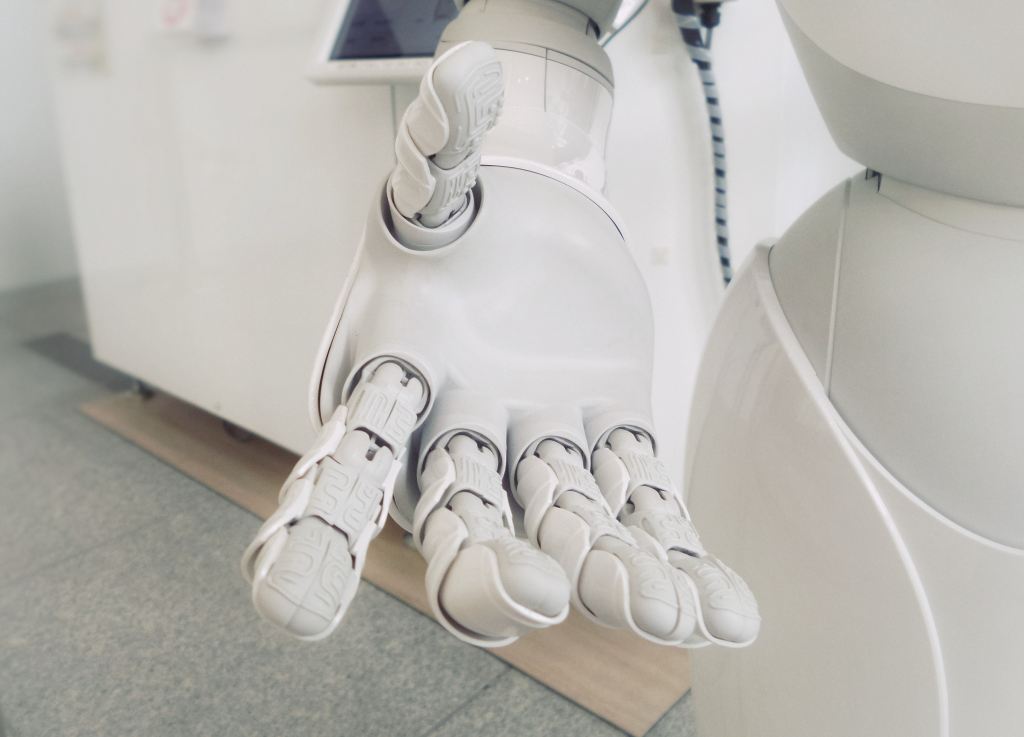
The line that stuck out to me most in Schrager and Wang’s article on robots and AI in the educational environment was, “Instead of a helping hand for struggling students, imagine the outstretched fingers of a—better, faster, arguably more engaged—machine…. [AI] is, some say, the future of work —one day replacing masses of humans in the workforce, if not entirely” (Schrager, 2017, p.4). While machines have assisted in easing the burden of much manual and technical labor, my question is: at what point does technological progress become more of a hindrance than a help?
If Artificial Intelligence advanced to the point of replacing humans in the workforce, the result would be putting masses of people out of a job, leaving them with no way to earn a living. Schrager and Wang’s article does describe the current situation as not being quite so extreme yet though. For the moment, AI is only being experimented with in the sense of it being an educational aid or tutor at these universities to prevent professors from being overwhelmed (2017, p.4-5). However, like all forms of technological advancement, AI is going to continue to evolve.
In regards to how AI could affect the work force, I found a document called “AI, Robotics, and the Future of Jobs” by Aaron Smith and Janna Anderson. It contains highlights and key findings of a canvassing done among technological experts and analysts in 2014 called The Future of the Internet (p.1). The result of the canvassing was split with a 4% difference of opinion. 48% of the experts interviewed believed robots and AI could “[displace] significant numbers of both blue- and white-collar workers” by 2025, while 52% believe “human ingenuity will create new jobs, industries, and ways to make a living” (2014, p.2). While the higher percentage of experts believe new jobs will continue to be created, I find myself feeling a bit skeptical as to how smooth the transition will be.
The article goes on to point out that “many [experts] are concerned that our existing social structures— and especially our educational institutions—are not adequately preparing people for the skills that will be needed in the job market of the future” (Smith & Anderson, 2014, p.2). Maybe human ingenuity will be able to create more jobs as AI overtakes the jobs humans already perform currently; however, that could take an immense time of adjustment, especially if people aren’t being prepared for how the job market is shifting. In the meantime, people would lose their jobs and then scramble to find their footing in a society that wasn’t prepared for this type of change.
However, this future scenario wouldn’t be the first time the work force had to be reinvented. Despite my skepticism, there could be a possibility of new jobs being invented and provided to people without causing mass chaos. And in the meantime, AI could be beneficial as far individualized learning and allowing students to get the help they need in such a way that wouldn’t leave educators in a position of overextending themselves.
References
Schrager, A & Wang, A. X. (2017). 2 universities may soon replace professors with AI and robots. Quartz. Retrieved from https://utk.instructure.com/courses/94374/files/folder/Readings%20for%20Blogging/2nd%20Blog?preview=4725561
Smith, A., & Anderson, J. (2014). AI, Robotics, and the Future of Jobs. Pew Research Center, 6. Retrieved from http://www.fusbp.com/wp-content/uploads/2010/07/AI-and-Robotics-Impact-on-Future-Pew-Survey.pdf

